
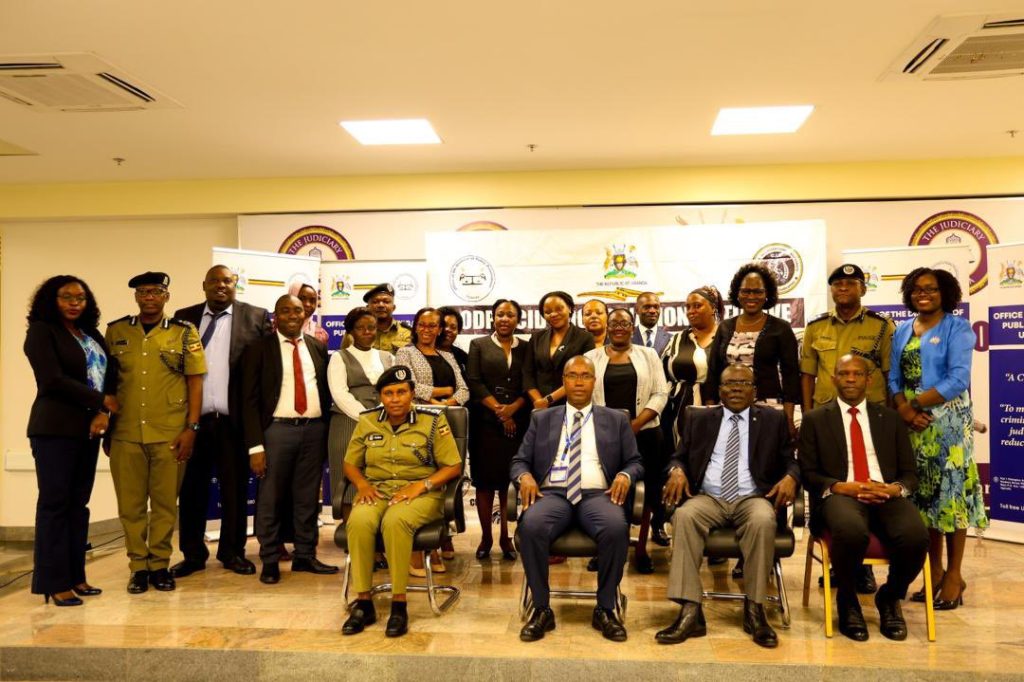
Held under the weight of shared responsibility and rising national expectations, the high-level meeting served as a platform for prosecutors and investigators to reinforce a growing synergy.
At its heart was a solemn commitment to deliver justice that is not only done, but visibly done swiftly, effectively, and fairly.
Representing the Director of Public Prosecutions, Mr. John Baptist Asiimwe, Deputy DPP – Management Support Services, delivered an impassioned address, echoing the urgency for joint action. “What affects the CID inevitably affects the ODPP, hence the need to flap in unison,” he declared.
His remarks underscored the deep interdependence between the two entities and the need for unity, especially as Uganda edges toward a politically sensitive electoral season marked by legal complexity and intense public scrutiny.
From the CID’s side, SCP Beata Chelimo, Deputy Director CID, hailed the reinvigorated collaboration between the two institutions.
Representing the Director CID, she described the evolving relationship as, “A partnership that is steadily transforming and becoming transformational.”
She emphasized that both ODPP and CID serve as the backbone of the country’s criminal justice system, calling for continued strengthening of their joint operations.
A compelling presentation by Mr. Job Cedric Osuret, Director of Analysis and Monitoring at the Financial Intelligence Authority (FIA), shifted the focus to financial crimes.
He highlighted the vital role prosecutors and investigators play in combating money laundering and terrorist financing, warning that Uganda must enhance its systems to avoid being re-listed on the Financial Action Task Force’s (FATF) Grey List. He called for more robust and coordinated action to close gaps in the country’s financial crime response.
Operational realities were candidly laid bare by ACP Odong Mark, Deputy Director CID. He pointed to significant staffing shortages in districts such as Rubanda, Napak, Nabikatuk, and Terego, noting how these gaps hinder prosecutorial effectiveness.
He also cited critical challenges, including limited investigative tools, weak exhibit management practices, and delays caused by the procedural requirement for audits in corruption cases.
The summit also addressed a troubling rise in illegal out-of-court settlements in Sexual and Gender-Based Violence (SGBV) cases. Deputy DPP for Prosecutions and International Affairs, Mr. Odumbi James Owere, voiced deep concern over these developments and the frequent absenteeism of witnesses, both of which he said undermine justice. He issued a strong call for cultural and institutional reform to ensure perpetrators are held accountable.
In a dynamic and solutions-driven discussion session that followed, participants crafted strategies to boost witness preparation and court attendance, expand ODPP staffing in underserved areas, enhance the chain of custody for exhibits, and intensify efforts to combat urban crime. Coordination in managing court martial cases was also a key discussion point.
Among the summit’s most forward-looking proposals was the introduction of integrated digital information systems.
These systems would enable seamless case tracking and evidence sharing across institutions streamlining operations and improving accountability.
In his closing remarks, Mr. Odumbi issued a powerful call for institutional harmony.
“We must discourage growth in silos and instead strive together towards a criminal justice system that is responsive, resilient, and fair,” he said, capturing the spirit of unity that defined the summit.
The event closed with renewed optimism, setting the stage for a more collaborative and effective justice system in Uganda one built not just on mandates, but on shared mission and mutual trust.