
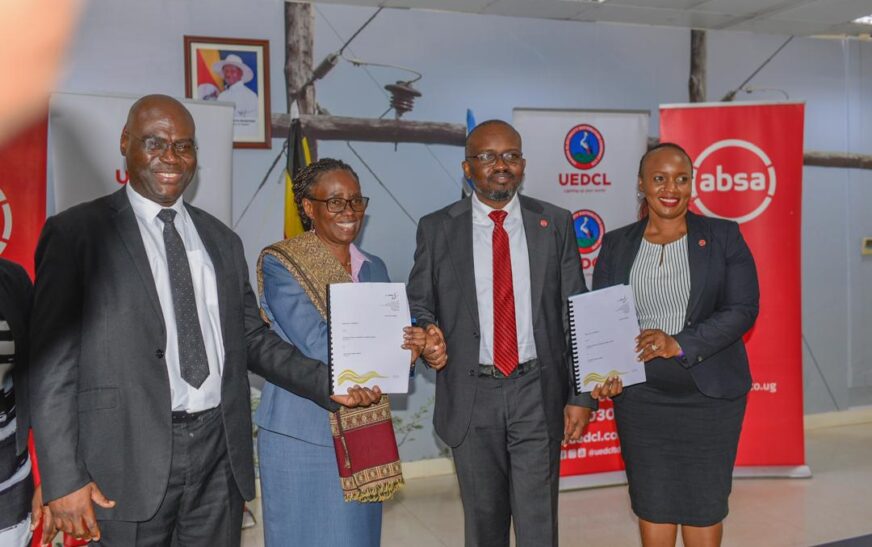
Uganda Electricity Distribution Company Limited (UEDCL) has moved to unlock fresh investment for the power sector after securing a Shs190 billion (USD 50 million) loan from Absa Bank to overhaul and extend the country’s electricity distribution network.
The financing arrangement was confirmed on Monday when UEDCL and Absa Bank signed a memorandum of understanding, following clearance from the Ministry of Energy and Mineral Development and the Ministry of Finance, Planning and Economic Development, the government’s representatives in the utility.
UEDCL Managing Director Paul Mwesigwa said the facility marks a significant shift for the state-owned distributor, highlighting its growing capacity to attract affordable funding from the market.
“This loan agreement with Absa Bank will benefit Ugandans. It shows that as a government-owned company, UEDCL can raise capital at a financing rate of less than 8 percent gross of tax, compared to 28 percent previously, with the loan repayable over five years,” Mwesigwa said.
He said the decision to secure the loan on UEDCL’s own balance sheet reflects increasing confidence in the company’s management and financial standing.
“This is a fundamental demonstration that a government company can go to the market and secure funding based on its own performance. We are committed to putting this money to good use and repaying it on time. According to our five-year strategic plan, the electricity network requires about USD 995 million over the next five years,” Mwesigwa said.
The funds will be channeled into critical network investments, including the construction of new substations and the reinforcement of overstretched feeders and transformers that have affected supply in high-demand areas.
Among the priority projects is a substation in the Magigye–Kasangati corridor to serve Kasangati and Gayaza, alongside a major facility covering Nakasero Hill, Kololo, William Street, and Makerere, aimed at stabilizing power supply in Kampala. Additional network designs also target Mukono, Nantabulirwa village, and surrounding communities.
“As a result, within the next two years since we took over, we expect most parts of the country to experience improved and stable electricity supply,” Mwesigwa said.
He noted that the sharp reduction in financing costs from 28 percent to 8 percent is expected to translate into benefits for consumers, including lower pressure on electricity tariffs and improved service reliability.
UEDCL says network optimization efforts have already boosted available power by 13 percent, from 986 megawatts to a peak of 1,115 megawatts, though the higher uptake from the transmission system has increased strain on existing infrastructure.
According to Mwesigwa, the new financing will help ease these constraints and strengthen the resilience of the distribution network.
UEDCL Board Chairperson Lydia Ochieng-Obbo said the deal underscores the value of partnerships between government institutions and private financiers.
“This partnership brings together a public sector entity and a private sector institution, with the private sector supporting the Government of Uganda in mobilizing much-needed capital to invest in, repair, and expand the electricity distribution network,” she said.
Absa Bank Chief Executive Officer David Wandera said the bank views the transaction as part of its broader commitment to national development.
“At Absa, we believe electricity ignites growth by supporting industry and improving people’s lives. Through this USD 50 million facility, we are proud to play a significant role in transforming the energy sector, the economy, and the livelihoods of Ugandans,” Wandera said.