
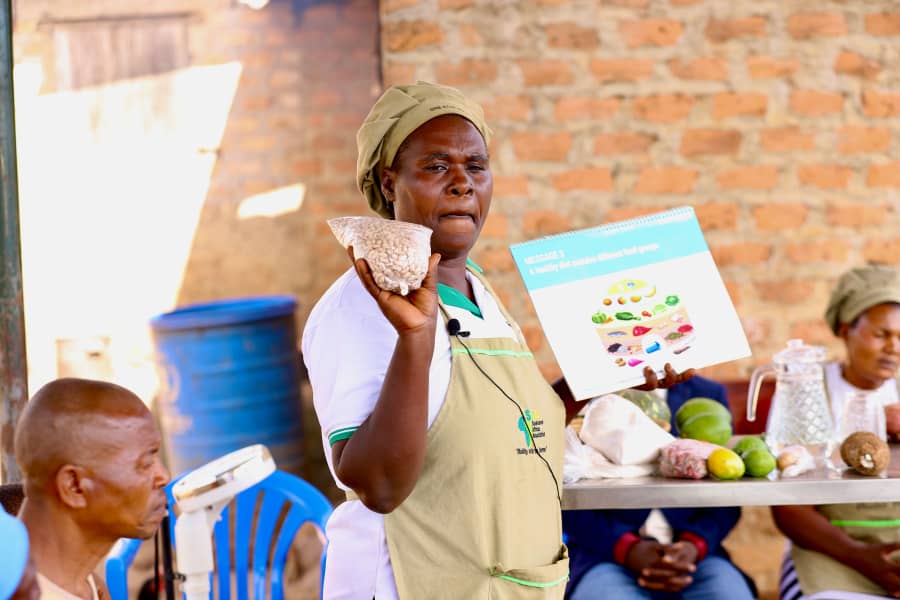
In Mubende District, a quiet revolution in household nutrition is reshaping families and restoring community well-being, thanks to a grassroots model introduced by the Sasakawa Africa Association (SAA).
What began as basic nutrition training has evolved into a community-wide effort that is reducing malnutrition, boosting incomes, and improving household stability.
Across Madudu Village, small kitchen gardens now flourish behind homes—feeding families and providing an unexpected new source of income.
Residents grow cabbages, pumpkins, greens and other vegetables within arm’s reach of their kitchens.
According to Aisha Nakibuule, the Commercial Community-Based Facilitator leading the effort, these gardens have transformed daily life.
“These gardens not only provide food and sauce to the family, but have turned out to be a source of livelihood in some homes, whereby parents with bigger gardens sell off the surplus from their harvest.” 
Nakibuule said families have embraced the gardens because they offer both food security and financial relief. “Many have adopted them.”
Nakibuule was supported with orange-fleshed sweet potatoes, biofortified crops and iron-rich beans.
Her “Nutrition Model Home” now functions as the training center for caregivers across eleven local councils.
With support from Sasakawa, she collaborates with Madudu Health Centre III to identify malnutrition cases and train mothers on proper child feeding.
“I was introduced to Sasakawa in 2019. I embarked on sensitizing parents about a balanced diet and proper feeding of children,” she explained.
“In the eleven local councils where I operate, we used to register over 500 cases of malnutrition, but ever since then, these cases have dropped to below 200, and we are looking to have this number reduced to zero.”
Nakibuule added that many mothers had little knowledge about feeding infants appropriately.
“You find that many parents, especially those with children below two years, want to feed them in the same way they feed themselves,” she said.
“A mother wants to cook one type of meal without any greens for a full week, but after sensitization many have been able to completely change their meal timetable.”
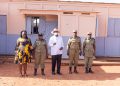
Sasakawa has also provided the community with a multipurpose shade for nutrition meetings—now sometimes used for immunization clinics—and introduced iron-rich beans that are still being grown widely in the area. 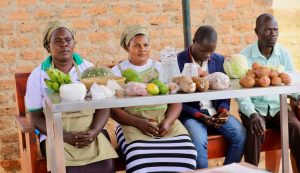
Health workers report not only better nutrition, but reduced family conflicts linked to food insecurity.
Dr. Samuel Ifugute, the Health Assistant at Madudu Health Centre III, said the collaboration has strengthened community health systems.
“We always work with Aisha and support her in all her operations,” he stated.
He further explained a common challenge the community faced.
“We realized that most people are not natives and they lack land to farm, and in case they fail to provide for their families, they end up battering their wives, hence an increase in cases of gender-based violence.”
Before Sasakawa’s intervention, malnutrition and domestic violence cases overwhelmed the health centre.
“Before Sasakawa’s intervention, we used to receive an overwhelming number of cases, but with Sasakawa’s support, referrals dropped to about one case within a period of three to six months,” he said.
For many families, nutrition training has also triggered agricultural transformation.
Dorotia Namuli, a beneficiary, said simple changes in farming practices have doubled her harvests.
“We used to harvest four bags of maize per acre, but recently when I planted three acres of maize, I harvested six bags per acre,” she revealed.
“It is this money that I used to buy these two cows which are providing me with manure, and I have hope that a few months from now, they will provide me with milk.”
Sasakawa Africa Association says the progress witnessed in Mubende is the reason behind its annual media engagements.
Ethiopia Tadesse, the organization’s Communications and Advocacy Officer noted that the program aims at uplifting people’s wellbeing.
“As Sasakawa, we have done a lot. We can’t be everywhere, but the media can amplify our success stories to the public.”
She noted that similar community transformations are happening in every African country where Sasakawa works:
“She added that this proactive is carried out in all other African countries Sasakawa operate.”