
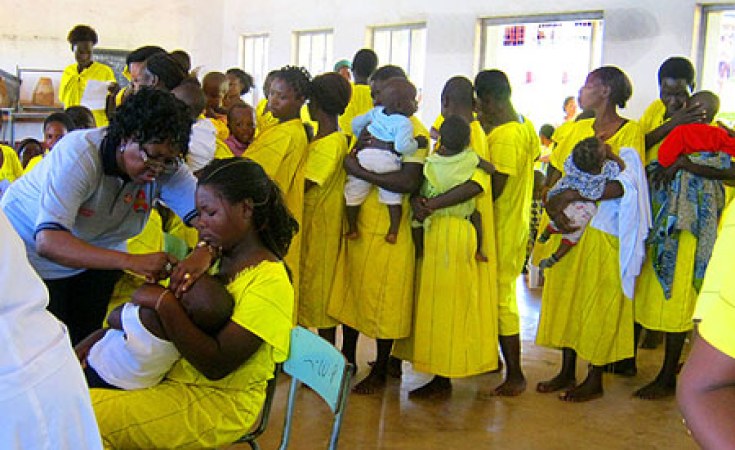
The Uganda Prisons Service has revealed that at least 294 babies are currently living in prison facilities across the country alongside their incarcerated mothers, a situation officials say is worsening congestion in already overcrowded prisons.
The disclosure was made by Aggrey Aturwanirire, Commissioner of Prisons in charge of Planning, while appearing before Parliament’s Committee on Defence and Internal Affairs on January 23, 2026, to present the Uganda Prisons Service National Budget Framework Paper for the 2026/27 financial year.
“We are also reporting on the daily average of prisoners and we are saying that some of the female prisoners have babies. We currently have an addition of 294 babies who are staying with their mothers in prison,” Aturwanirire told the committee.
The revelation sparked debate among legislators, with Wilson Kagyenjwe, the MP for Nyabushozi County, questioning how the babies end up in prison in the first place.
“I thought your question would be, do these mothers come pregnant or do they get pregnant while in prison? That is a strategic question. Otherwise, how can the whole country continue having babies in prisons? Something has to be done,” Kagyenjwe said.
However, the Deputy Commissioner General of Prisons, Samuel Akena, dismissed claims that women become pregnant while incarcerated, saying strict medical procedures are followed when inmates are admitted.
“Our systems are very clear. Mothers either come with babies already or they are pregnant at the time of admission. They do not get pregnant while in prison,” Akena said.
He explained that by law, children are allowed to stay with their mothers for up to 18 months, though in some cases this is extended to 24 months.
“When they reach prison with these children, they do not want to release them because the minimum conditions we offer are sometimes better than what these children face outside. We try to make life a little better for them,” he added.
Akena further revealed that Uganda Prisons operates baby care centres in major women’s prisons, where infants are provided with basic services such as healthcare, nutrition, and shelter.
He also noted that some women are arrested while pregnant and later give birth while serving their sentences.
“Yes, it is also true that a woman can come when she is pregnant. She commits a crime today, gets arrested, and is already carrying a child. During pre-entry screening, we conduct pregnancy tests and other health checks, including for HIV, TB, and other conditions,” Akena said.
He added that women serving long sentences may give birth while in custody, making it unavoidable for the babies to spend their early months in prison.
The presence of infants in prison highlights the broader challenges facing Uganda’s correctional system, particularly overcrowding, limited resources, and the need for special care for vulnerable groups within detention facilities.